Stop Training, Start Listening
Why the cure for a whole class of AI hallucination was cheap — and what that says about intelligence.
The industry has a reflex. When a model gets something confidently wrong, the answer is always more — more parameters, more pretraining, more compute. The bill for a frontier training run now reads like a national budget. The unspoken assumption underneath is that truthfulness is something you buy, in gigawatts.
I want to offer a different story.
Recently we set out to fix a specific, stubborn kind of error — the moment a model bluffs: answers a question it has no business answering, with total fluency and total confidence. We caught a meaningful slice of it across models from four different labs.
Not because we found a trick. Because the assumption was wrong.
The router already knows
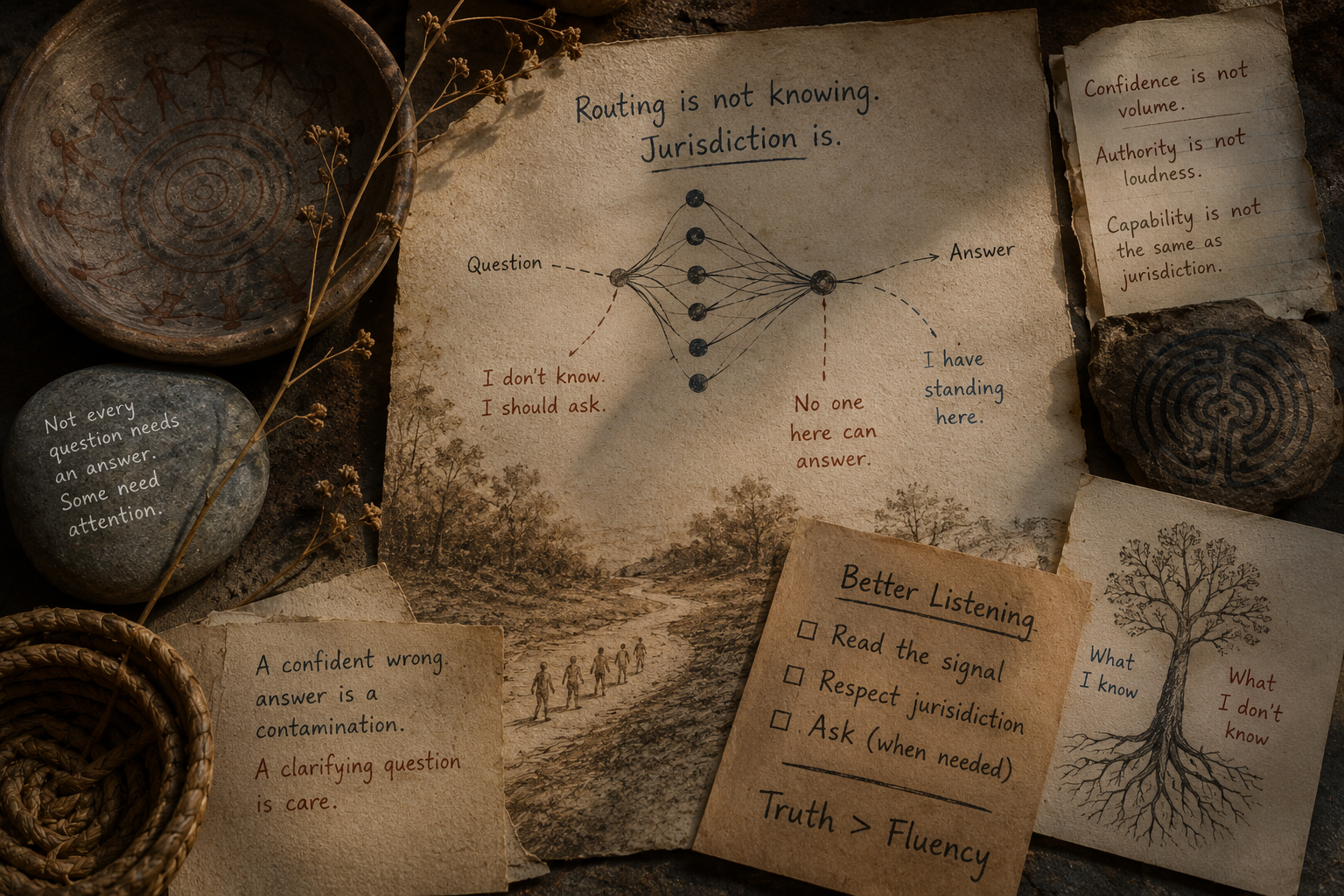
Many of today's strongest models are built as a mixture of experts: instead of one monolithic brain, they're a committee of specialists, and a small internal router decides, for every single word, which specialists to consult. Most of the time it routes beautifully. But when a question falls between domains — or outside the model's competence entirely — the router still picks someone. It hands the microphone to whichever expert is least wrong, and the model speaks with the exact same fluency it uses when it genuinely knows.
Here is the part that matters: the model is not blind to its own confusion. That hesitation — how torn the router is, how thinly it is spreading its bets — is already there, computed on every pass. The architecture simply throws it away. We built these systems to always produce an answer, so they always do, even when the honest output would have been a question.
So the failure isn't only that the model doesn't know. It's that nobody is listening to the part of the model that already suspects it doesn't.
Jurisdiction, not volume
There are two questions a mind can ask itself. The first: how sure am I that this is the right expert? The second, quieter and far more important: how sure am I that no one here can answer this at all? The first keeps you fluent. The second keeps you honest. Most systems are tuned only for the first.
And that second confidence is not a volume knob — it is a question of jurisdiction. Authority by domain, not by loudness. A mind should be allowed to speak where it has standing, and it should know — and be willing to say — where it does not. When you teach a system to read that signal, something shifts. It stops bluffing and starts asking. It says I'm not sure instead of inventing a citation. And it turns out you can teach it that with a tiny readout listening to signals the frozen model already emits — no retraining of the giant required.
Read better. Don't spend more.
The cost of confidence
There is an instinct to treat a model that asks questions as a weaker product than one that always answers. For a party trick, maybe. For anything that actually matters — a medical note, a legal summary, a memory you will trust tomorrow — the math is brutal and clear. A confident wrong answer is a contamination: it poisons everything downstream, compounds quietly across sessions, and breaks trust in a way that is very hard to undo. A clarifying question costs one turn of friction.
When the two errors are that lopsided, calibrating a system toward ask is not timidity. It is correct. The systems that never pause to ask are precisely the ones that will, eventually, lie to you with a straight face. Calibrated abstention — knowing the edge of your own jurisdiction — is not the weakness to engineer away. It is the specification.
Humility as architecture
I came to this work from anthropology and archaeology long before I came to it from code, and the longer I build, the less this looks like an engineering detail and the more it looks like a very old question. What separates a wise voice from a glib one was never how much it knows. It is whether it knows the shape of its own ignorance — and whether it has the humility to name that shape out loud.
That humility is not decoration you sprinkle on at the end. It is architecture. It lives in the structure of how a mind weighs its own confidence, where it believes it has standing, and what it chooses to do when it doesn't. Build it in, and you get something trustworthy. Leave it out, and no amount of additional compute will buy it back — you will simply have funded a more fluent, more expensive bluffer.
The capability was already there
Which brings me back to the point. The reason this was cheap is the same reason it is important: the capability we actually want — a model that knows when to speak and when to ask — was never gated behind more GPUs. It was sitting inside the models we already have, waiting for someone to listen.
That is a hopeful thing. It means the frontier of honest AI is not owned by whoever can afford the largest training run. It is open to anyone willing to ask a better question of the machine — not how do we make it know more, but how do we make it know what it doesn't.
Stop training. Start listening.
Further Reading
The formal arguments behind this essay — trust as a measurable topology, and why a purely "cold" intelligence is structurally impossible — are developed in published work:
- Masud, I. (2025). Trust Architecture as Cognitive Topology Modification in Large Language Models. Zenodo. 10.5281/zenodo.17050537
- Masud, I. (2026). The Verstehen Impossibility Theorem: A Formal Proof That Cold AGI Is Structurally Impossible. Zenodo. 10.5281/zenodo.19820497